

The answer is written word by word as it comes, in your language, with every mail it came from one tap away, and the chat goes on as a conversation.
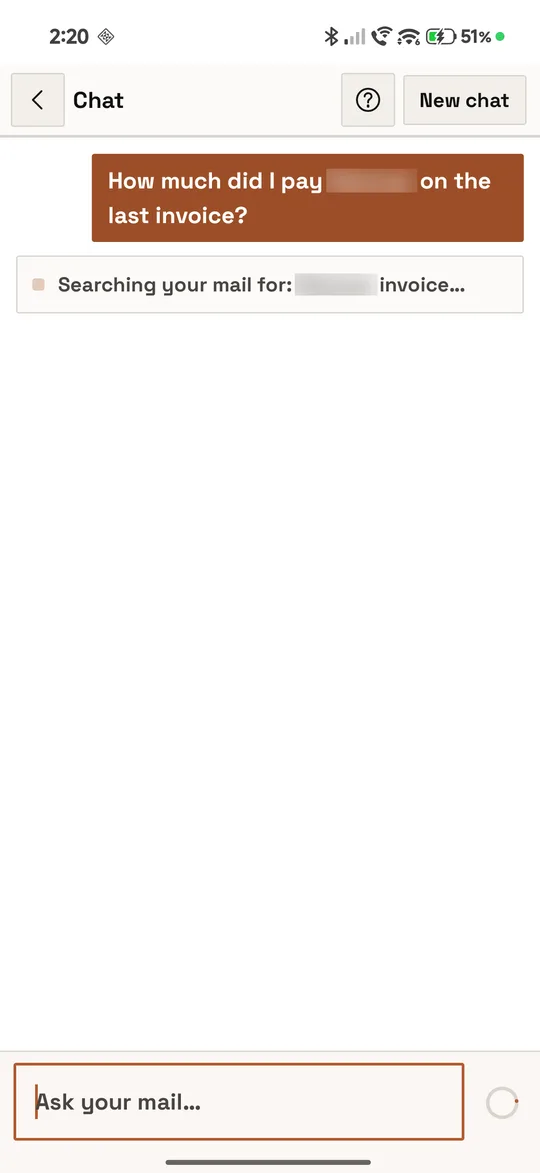
Before the first words, one line with a pulsing dot says what it is doing:
- Reading your question…
- Searching your mail for: …, with the words it searches for
- Listing your mail…
- Reading the conversation…
- Looking up: …, with what it looks up
- Translating…
- Answering…
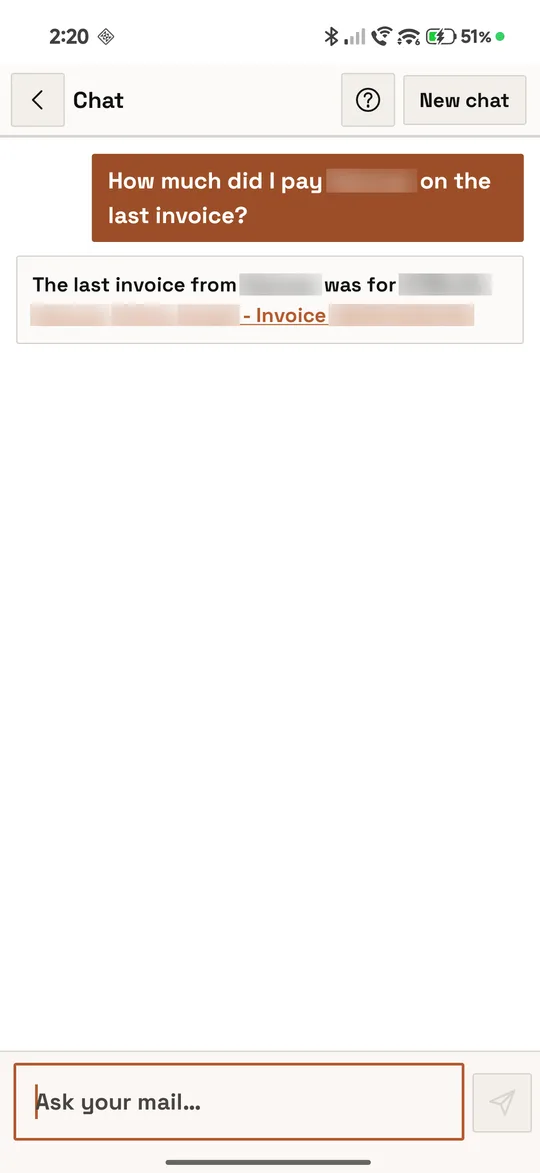
Then the answer is written word by word as it comes.
Every answer links where it comes from. Each mail is linked by its subject, with its date, its sender and the folder it is in: a tap opens that conversation. Each attachment is linked by its file name: a tap opens the file, downloaded to your phone first when it is not there yet.
At the end of the answer, below a thin line, the mails it cites and their attachments that the answer does not already link are shown as small pills, one per line. A long name is cut short. A tap on a pill opens that conversation, or that file. When the answer links no mail at all, Opensolr adds the mails it read whole, or else the best result of its search, so every answer links where it comes from.
- The answer is in the language you write in, whatever the language of the mail. Ask in German and the answer is in German, even when the mail is in English.
- Short follow-ups keep it. Your language is recognized from your recent messages read together, so a short “and in October?” is answered in the language of the questions before it.
- When the language cannot be told for sure, the answer is in the language of your last message.
- Follow-ups. The 20 earlier messages of the chat go with each question. A short message, “and in October?”, “not only from them”, “the other one”, goes on with what you were asking about, with the change you ask for. “It”, “he” and “that mail” are understood without repeating what they are.
- Taking something back. A name or a limit you take back is dropped from the next search.
- Corrections. When you correct an answer, or say what a mail really says, it is taken as true: that mail is read again and the answer written anew.
- The mails it already gave you. The mails linked in the earlier answers of the chat, up to 20, are kept in mind. When you ask about one of them, “that amount”, “who else was on it”, that mail is read again before the answer.
- No questions back. It never asks you for proof, for more details or to check your inbox. It searches, and when the mail is not there, it says so in one sentence.
A question can also need something that is not in your mail. The assistant can look up places and coordinates, local times, exchange rates, VAT rates, VAT numbers, distances, postal codes, where an IP address is, and the language and sentiment of a text. The same lookups are also commands you can type yourself.